FTTx stands for the fiber-optic connectivity of the future. From FTTC and FTTB to Fiber to the Home (FTTH), the various deployment stages describe the path of high-performance fiber-optic networks all the way to the end user. With extensive networking expertise and a comprehensive FTTH product portfolio, Schrack Technik supports the implementation of modern fiber-optic infrastructures.
View all products in the online shop
FTTx (Fiber to the x) refers to the various deployment stages of fiber-optic networks and describes how far the fiber is extended towards the end user. The technology forms the foundation for future-proof communication infrastructures in single-family homes, multi-dwelling residential buildings, housing developments, as well as office and commercial buildings.
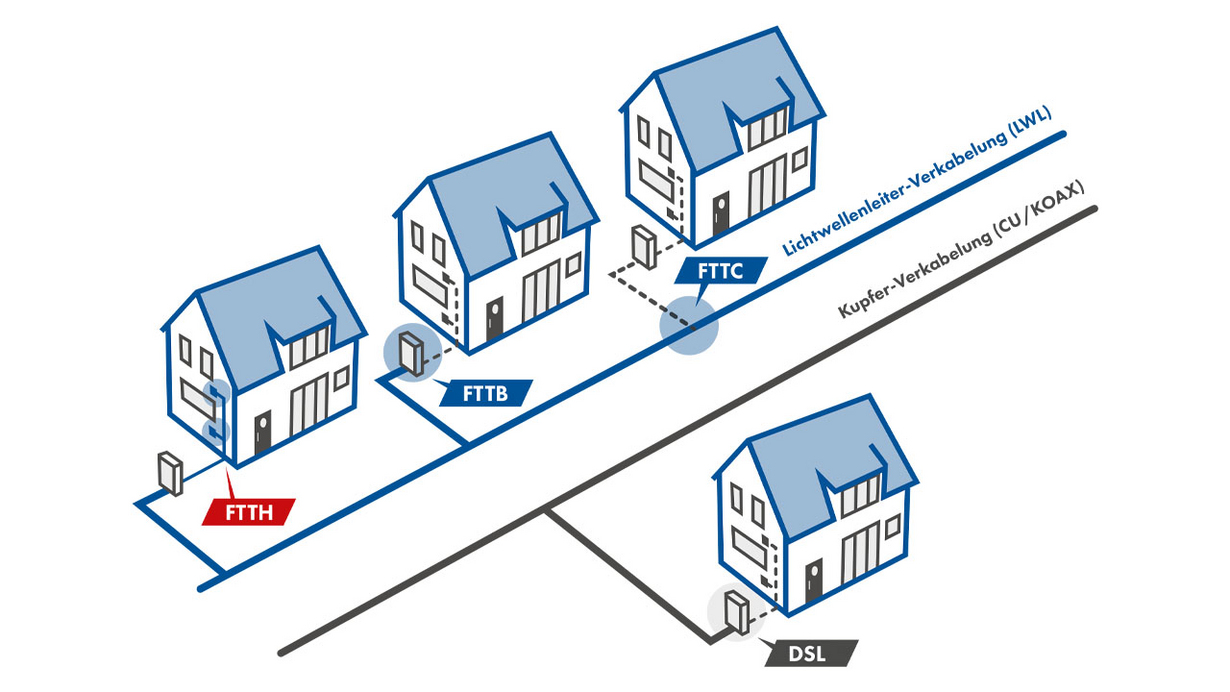
Depending on the network architecture, the fiber-optic cable terminates at different points:
FTTN is a technology in which the fiber-optic cabling is deployed up to a central node (distribution point) within a neighborhood. The “last mile” connection to the house, apartment, or subscriber is then provided via the existing copper cabling infrastructure.
FTTLA is a technology in which the fiber-optic cabling is deployed up to a local node (amplifier station), located either in the street or within a building. The “last mile” connection to the house, apartment, or subscriber is then provided via the existing copper coaxial cabling infrastructure.
FTTS/FTTC is a technology in which the fiber-optic cabling is deployed up to a local distribution point (street cabinet) located close to the subscriber. The “last meters” to the house, apartment, or subscriber are then covered using existing copper cabling.
FTTDP/FTTB is a technology in which the fiber-optic cabling is deployed up to the final distribution point (distribution cabinet), located either in the building basement or at the property boundary. The “last meters” to the subscriber are then covered using the existing copper cabling infrastructure.
Option 1: Fiber-optic cabling (FO) directly into the building, with the internal distribution completed via copper cabling.
Option 2: Fiber-optic cabling (FO) to an outdoor distribution cabinet, with the remaining connection completed via copper cabling.
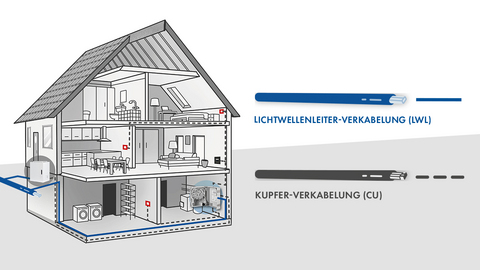
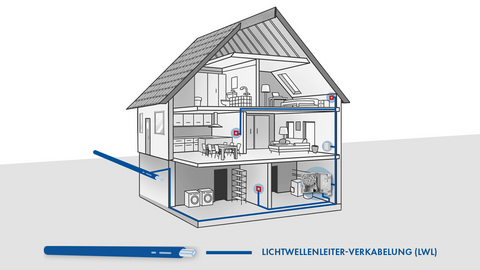
FTTP/FTTH is a technology in which the fiber-optic cabling is deployed directly to the subscriber, completely replacing copper cabling throughout the connection. It is the most powerful and future-proof technology for broadband network access.
| Network level | Description | Example |
|---|---|---|
| NL1 | Long-haul network / Backbone | Nationwide fiber-optic networks (service providers, network operators, etc.) |
| NL2 | Regional or metropolitan network | Connection from the backbone to a city or region, terminating at a central node |
| NL3 | Distribution network (street/building) | Fiber-optic or copper cabling to a local distribution point and/or the final distribution point (building entry point) |
| NL4 | In-building network | Connection from the building entry point to the subscriber |
| NL5 | End-user devices | Router, television, telephone, etc. |
Article 10 of the GIA and OVE R 41 are significantly accelerating the expansion of in-building fiber-optic infrastructures. As a result, electricians can benefit from a new and future-oriented field of installation services, offering attractive business opportunities related to the deployment of FTTH solutions.
Schrack Technik continuously expands its FTTx product portfolio and already offers key components for the professional implementation of fiber-optic infrastructures. With practical solutions such as our FTTH roller boxes, installations can be carried out efficiently and reliably – even without extensive specialist knowledge of fiber-optic technology.
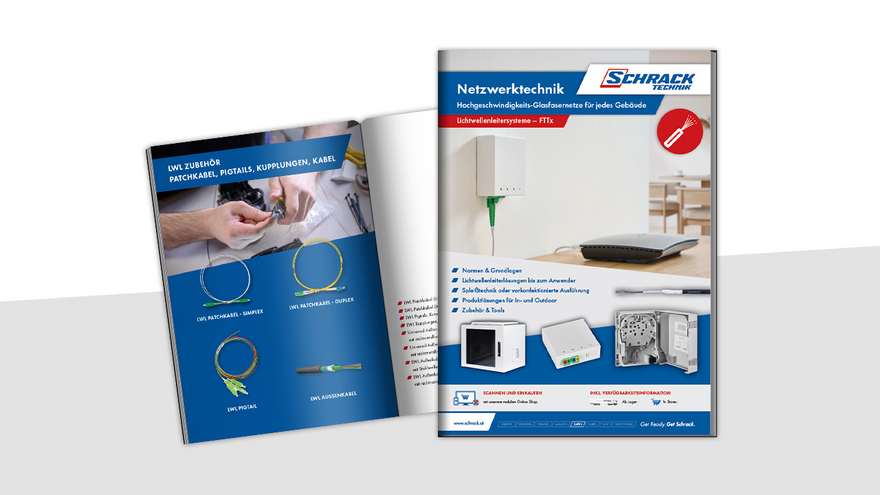
Our FTTx Networking Catalogue provides a comprehensive overview of the relevant Schrack Technik product portfolio for modern fiber-optic infrastructures.
A special highlight: Explore detailed technical information on FTTx, including standards, networking fundamentals, and fiber-optic cabling technologies.
There are five network levels:
Together, they form the complete infrastructure from the supra-regional fiber-optic network all the way to the end-user device.
The difference between FTTB (Fiber to the Building) and FTTH (Fiber to the Home) lies in how far the fiber-optic cable is deployed.
With FTTB, the fiber reaches the building, while the final connection to the subscriber is provided via copper cabling. With FTTH, the fiber-optic cable is installed directly to the subscriber, enabling maximum performance and future-proof connectivity.
Fiber-optic infrastructure will become mandatory in buildings to comply with the requirements of the Gigabit Infrastructure Act (GIA) and to create a future-proof foundation for high-performance gigabit and fiber-optic networks. This ensures that new and extensively renovated buildings are prepared to meet future connectivity demands.
Fiber-optic cabling offers significantly higher bandwidth, longer transmission distances, and greater immunity to interference than copper cabling. It is also considered particularly future-proof and forms the foundation of modern gigabit networks.
Depending on the application, an FTTH installation typically requires fiber-optic cables, FTTH outlets or roller boxes, adapters, pigtails, and the appropriate accessories and tools for installing and testing the fiber-optic connection.