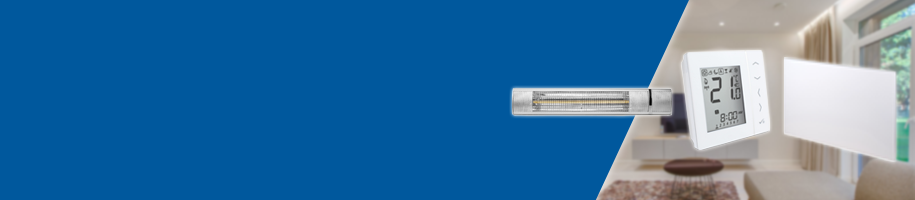
Schrack Technik offers various heating panels for wall and/or ceiling mounting for your infrared heating system as well as the matching control unit.
Your special advantages and features
- Panels for wall or ceiling installation
- Great variety of power classes
- Control: Easy, radio, SmartHome, wired
- Radiant heater with step control
- Mounting accessories
Most people feel very cosy in the warmth of an open fire or the sun. This comfortable sensation comes from a fair portion of harmless infrared radiation, giving us this warm and fuzzy feeling. Infrared radiation is an essential natural component of our sun. 50% of the solar radiation that reaches the ground is infrared radiation. And the earth heated by the sun and all bodies also emit infrared radiation. The special thing about infrared is that as soon as it hits our skin, it is immediately perceived as heat. You can easily experience just that on a very cold winter's day: if we stand in the shade we freeze, as soon as we get in the sun we instantly feel warmer. And that is precisely what makes infrared heat so special. It is also the operating principle of all infrared heaters.
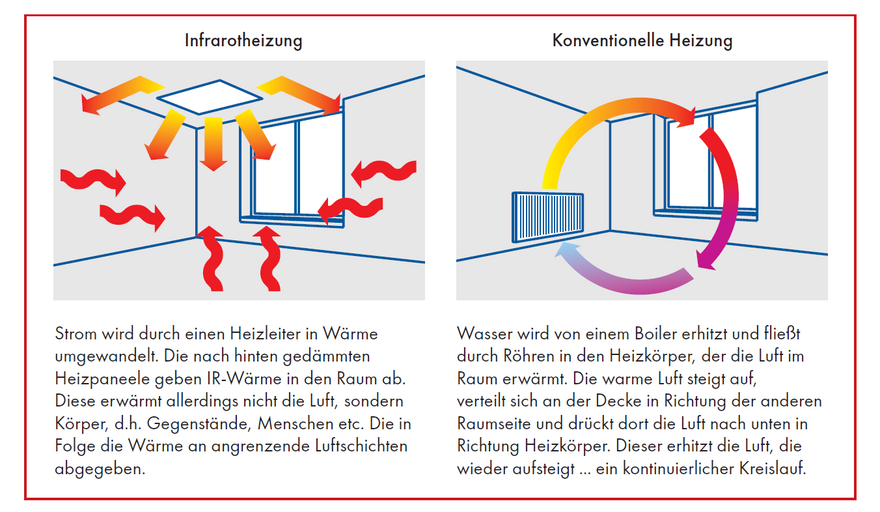
Infrared heaters do not heat the air, they heat objects. All objects heated by infrared slowly dissipate their stored heat into the room, meaning that all walls, objects etc. act as a heat reservoir. Therefore, even if you let fresh air into the room, most of the stored heat stays inside.
What is more, the many ecological and health benefits of infrared heating can make us feel another notch better. First of all, the low amount of power needed, which can also be generated in an environmentally friendly way, e.g. by photovoltaic systems. Then the infrared deep heat, which creates a pleasant, evenly distributed climate in the rooms, without swirling up dust from convector heating. All those are just a few reasons to feel good.
Infrared heat: copied from nature and put to efficient use for our comfort.
Compare and see the clear advandages
+ Low investment and maintenance costs
+ Easily adjustable in spring and autumn
+ Low air circulation and fewer hovering dust particles
+ Space saving - no boiler room required
+ Non-pollutant
- Fuel cannot be stored for future use
- Separate system required for hot water heating
- Low energy output from an existing PV system in winter
- More complex planning when used as the main heating system
+ Existing systems can be used
+ Fuel can be stored for future use
+ Usually includes hot water heating
+ Low planning effort
+ Insensitive to external influences (wet laundry on the radiator, etc.)
- Service and maintenance fees
- High electricity consumption and costs
- LAir circulation and dust movement
- Environmental impact: CO2, noise, odour
We experience infrared (IR) radiation every day in the form of solar radiation. In physics terms, IR radiation is an electromagnetic wave that lies beyond the red end of the light spectrum and propagates unimpeded at a wavelength of 780nm to 1µm. Every warm object emits infrared radiation. The hotter the surface, the shorter the wavelength and the more intense the radiation.
Depending on the wavelength, a distinction is made between A, B and C radiation. At higher temperatures, the radiation maximum of thermal radiation shifts to shorter wavelengths up to visible light. When infrared radiation meets our skin, we perceive it as heat. This effect can be utilised for heating.
Infrared bandwidths used in heaters
Short-wave radiators, also known as infrared radiators, have a surface temperature of at least 900°C. They glow red and require practically no warm-up time. They generate a radiation efficiency of over 90%.
The radiant heat is hardly affected by draught or wind. Therefore, these radiators are ideal for outdoor applications.
Medium-wave infrared radiators emit infrared radiation between 1,400nm and 3,000nm and have a surface temperature of 300 to 900°C. They do not produce any visible light. Therefore, they are also known as dark heaters, dark radiators or dark emitters. Medium-wave infrared heaters are used in closed rooms where a larger amount is heat is needed.
The term long-wave infrared radiators is used for heaters with a surface temperature of up to 200°C. Among those, wall-mounted panels usually have surface temperatures of approx. 100°C, ceiling-mounted panels go up to 200°C. The term infrared heating or heater came into use, because the maximum radiation output is in the infrared range. Infrared heating is ideal for heating living spaces, such as flats, houses, and other types of private homes.
Infrared heating is based on the principle of solar radiation
The radiant heat does not primarily heat the air. Rather, the ceiling, walls, objects and people absorb the emitted heat. All objects and things near the heater store the heat and emit it back into the room (secondary radiation). The homogeneous heating of the room creates a pleasant room climate in which losses due to rising warm air are largely avoided.
The soothing feeling of warmth
In addition, the combination of direct heat radiation in conjunction with the increased so-called envelope temperature of the room (wall temperature) creates a subjective feeling of warmth that is 2-3°C above the actual room air temperature. This means that the perceived temperature is higher than the actual room air temperature. This phenomenon also occurs on a cold winter's day. While in direct sunlight, the subjective feeling of warmth is higher than the actual air temperature.
A rule of thumb: the higher the wall temperature, the lower the required room air temperature for the same level of comfort.
IR heaters have a heating element made of graphite, carbon fibres or metal at their core which in turn heats up the surface of the heater. For better heat transfer, in some models the heating element is woven directly into the front panel of the heater.
An insulating layer behind the heating element, usually made of rock wool, ensures that the generated heat ratiates mainly into the room. This not only protects the wall and ceiling, but also increases the efficiency of the entire system. Occasionally, additional mirrors help to reflect the major share of the IR radiation generated into the room. The front panel can be made of glass, ceramic or metal and offers different design options depending on the material. Glass, for example, can be used to create surfaces that look like paintings or serve as bathroom mirrors. An important aspect to consider is the radiation surface of an infrared heater. Powerful systems with high temperatures during operation need large surfaces to be efficient. Otherwise, a large proportion of the radiation generated would remain unused. Glass and mirrors minimise the efficiency of an IR panel.
The all-rounder – of good use almost anywhere
Infrared heating systems can be installed in almost every conceivable area of application, from new buildings to period buildings or in offices, workshops, and so on. IR heating systems are suitable both as a full-scale heating system, as a replacement for inefficient and expensive heating systems (e.g. night storage heaters), or as supplementary heating.
Low power ratings, precisely defined operating times and individual room controls reduce heating times and also heating costs compared to conventional heating systems. The cosy warmth and healthy indoor climate increase the well-being of the inhabitants. And these are just some of the advantages that work in favour of using infrared heating systems. Infrared heaters not only save energy, they also impress with their simple and cost-effective installation, long-term maintenance-free operation, and flexible installation options.
If there is a temperature difference between two bodies that are not insulated from each other, heat flows from the higher to the lower temperature until the different temperatures have equalised. In physics, a distinction is made between three types of heat transfer:
Radiant heat or heat radiation
Heat transfer takes place following the optical laws of nature. Heat is radiated from any warm material to the cooler surroundings. Air almost causes no loss in radiation, because it hardly heats up. Infrared heaters and radiators utilise precisely this effect to heat rooms. Solid objects such as walls, furniture, people etc. absorb the heat radiation and reflect it back into the room. Radiant heat is physiologically favourable and pleasant. It creates a feeling of warmth and cosiness - similar to the sun's rays or a fire in a fireplace.
Heat conduction
Heat conduction is the direct transfer of heat through contact as it occurs on a hotplate for example. This type of heat transfer is not used for heating rooms.
Heat flow - convection
This principle of heat transfer has been used in almost all conventional heating systems to date, be it central heating, stove heating, electric storage heaters, convector heating, rapid heaters, or fan heaters.

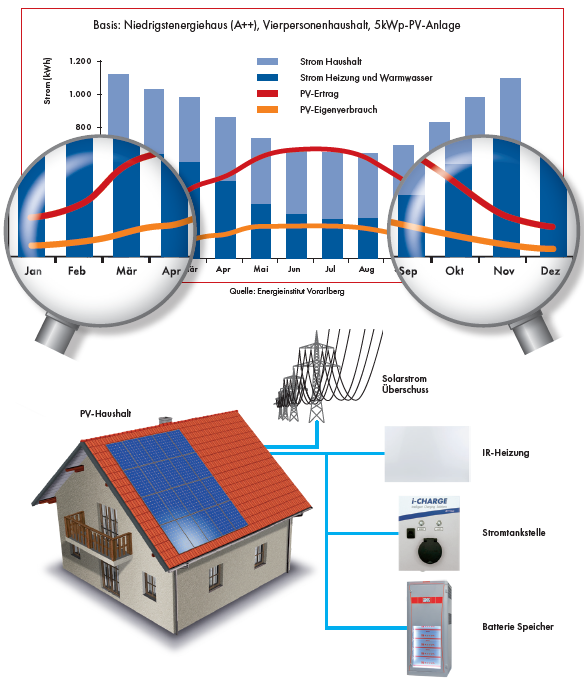
Combined with photovoltaic systems (with or without storage and with or without self-consumption optimisation), the infrared panels can also increase the degree of self-consumption of the system. As a result, operating the PV system becomes even more efficient. The benefit is a positive dual effect. Heating with the electrical power produced in one’s own PV system significantly increases the efficiency and utilisation level of the photovoltaic system. Particularly in times of strongly varying wather (spring/autumn), the energy from the photovoltaic system can be optimally used to operate the infrared heating system.
Additional product details
Infrared heaters do not heat the air, they heat objects. All objects heated by infrared slowly dissipate their stored heat into the room, i.e. all walls, objects etc. act as a heat reservoir. Even if you let fresh air into the room, not all the stored heat is lost.