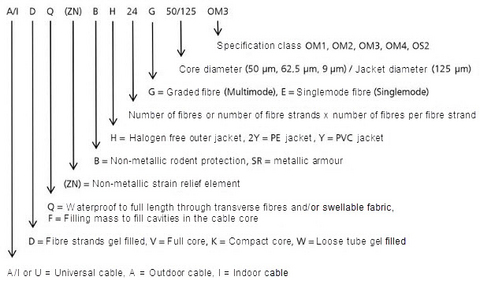
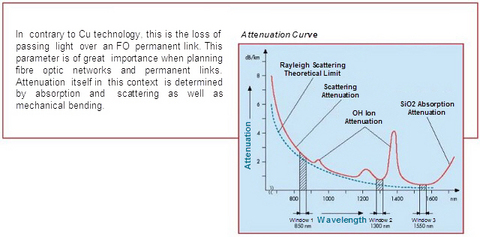
The EN 50173-1 standard describes different categories of fibre-optical cables (OM1, OM2, OM3, OM4, OS1, OS2) and different classes of FO channels (OF100, OF-300, OF-500, OF-2000, OF-5000, OF-10000).
Usually, quartz glass fibres of FO cables are categorised into multimode optical fibres with diameters of 50 µm or 62.5 µm and singlemode optical fibres with a diameter of 9 µm.
Light is the part of the electromagnetic spectrum that we can see. Electromagnetic waves disperse at the speed of light in a vacuum.
C0 = 300,000 km/s
Visible light only covers a small section (bandwidth) between 420 nm (violet) and 750 nm (red) of the spectrum. Fibre optical technology uses the infrared range of the spectrum between 800 nm and 1600 nm.
The more impulses (binary) are transmitted per time unit (sec) the higher is the transmission capacity of the fibre optic cable. This transmission capacity can be converted into a corresponding bandwidth. It is important to note that this bandwidth is available over the full length of the fibre optic channel. The ratio between max. transmission frequency and max. channel length can be specified in a mathematical formula as the bandwidth-length product. Therefore, in fibre optics technology it is important to consider this bandwidth-length product, along with the fibre attenuation, already when planning a fibre optic network.
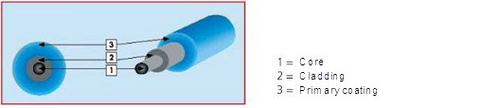
Generally, the core and cladding glass is quartz glass, which is made from quartz sand (SiO2). One of the most positive characteristics of this material is that it is available in abundance on Earth. The fibre optic conductor has a cylindrical core and a surrounding cladding. Due to the properties of the glass the core and cladding cylinder are sensitive to bending or twisting. To dampen such torsional and flexural stress, the glass is embedded in a primary cladding. This coating has several functions: mechanical protection, protection of the fibre from ingress of moisture (H2O would diffuse into the fibre optic conductor), colour coding of loose tube cables.