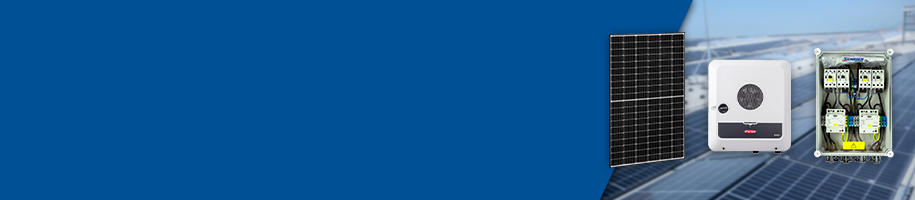
Schrack Technik offers a comprehensive range of products from PV modules to surge protection suited for what is considered an ideally configured PV system.
Your special advantages and features
- High module capacities
- Inverters for versatile applications
- Mounting systems for pitched and flat roofs
- Protective devices for your PV system
- Kits for grid-tied & stand-alone systems
The inhabitants of the planet Earth have vast resources in renewable energies at their disposal, such as solar, wind or water power. Using these energy sources, we can generate electricity and heat in an environmentally friendly way and reduce the proportion of fossil fuels in our overall environment. The photovoltaic systems from Schrack Technik, which can be installed and applied almost anywhere, use the free, inexhaustible energy of the sun. The system sizes vary from the watt range to the megawatt range, meaning they adapt to the needs of all types of users and scenarios.
System installed, power is a go
A photovoltaic system’s core elements are the modules (solar cells) attached to a roof which convert the sun's rays into electrical energy. All Schrack Technik solar modules are notable for their long warranty times, their superior efficiency and high mechanical strength, a structured anti-reflective coating, and all the relevant test marks and certificates.
For converting the direct current to alternating current, a photovoltaic system uses a power inverter unit. Also in this segment, Schrack Technik offers a wide range of high-quality products (product overview inverters) in all the different power classes. Their electrical and mechanical properties are ideally suited for the purpose. Small and inconspicuous, they let operators generate electric power maintenance-free and highly efficiently. Operators of photovoltaic systems also have a variety of options regarding how they dedicate their generated electricity: they can feed the alternating current into the public grid using a meter and receive a compensation or consume the generated energy themselves.
Considering the frequency of storms rising significantly in recent years, the use of lightning current and surge arresters has become an increasingly important topic. Therefore, just like all other electrical appliances in the household, a photovoltaic system should be protected accordingly to maximise its yield and service life. The SCHRACK surge arrester boxes (product overview surge arresters) have been developed specifically with photovoltaic systems in mind and meet the highest possible safety standards.
A photovoltaic system yields the optimum amount of electricity if it is positioned outside of shaded areas all year round, if the modules’ inclination angle is between 20 and 35 degrees, and if it faces south, ideally. With an intelligent range of durable and high-quality photovoltaic kits and individual PV components, Schrack Technik can also meet individual requirements. It is essential to choose the right product combination or mounting kit (product overview mounting system) to optimally configure, mount and install a photovoltaic system.
The amount of electricity generated by a photovoltaic system naturally depends on the module, orientation, hours of sunshine, temperature, and roof pitch. For example, in Austria, one square metre receives about 1200-2000 kilowatt hours per year. As a result, the European Research Centre identifies a resulting energy production per year of 900-1500 kilowatt hours per square metre and per installed capacity of 1 kilowatt peak (unit of measurement of the nameplate capacity). According to "Statistik Austria 2008", an average Austrian household consumes about 4,400 kilowatt hours per year. A demand that can normally be covered by a photovoltaic system of 5 kilowatt peak. All you need is an area of about 40 square metres.
Additional product details
Photovoltaic systems on private houses cover about 20 to 30% of one's own electricity needs. The rest is fed into the public grid as surplus at very low electricity tariffs. An intelligent energy management system can raise the internal consumption to approx. 40 to 60%.